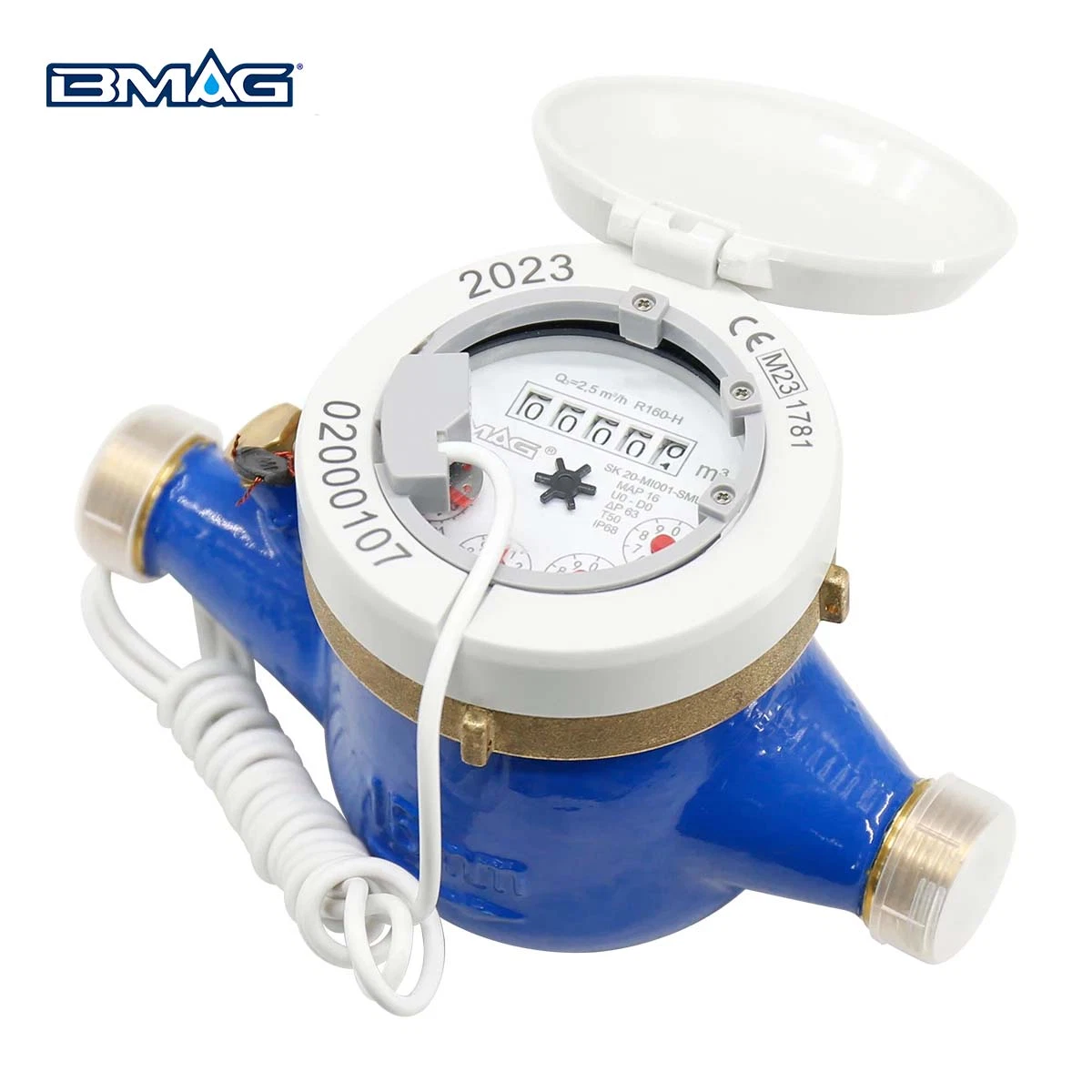
Large-diameter water meters refer to water meters with a nominal diameter of 50 mm or larger (DN ≥ 50). They are designed for applications with high water demand and are commonly used in agricultural irrigation, main water supply pipelines, fire protection systems, factories, ports, municipal water networks, and utility distribution systems. Due to their larger size and pipeline requirements, they typically use flanged connections.
Common sizes include:
- DN50 (2″)
- DN65 (2-1/2″)
- DN80 (3″)
- DN100 (4″)
- DN125 (5″)
- DN150 (6″)
- DN200 (8″)
- DN250 (10″)
- DN300 (12″)
Larger sizes are also available but may require customization. Different sizes suit different flow requirements. For example, DN80 meters can be used for water supply in office buildings and similar facilities, DN100 meters are suitable for medium-flow applications such as cooling-water systems in small and medium-sized factories, while DN150 meters are commonly used in municipal distribution networks, large commercial buildings, and other high-demand applications.
BMAG Large Diameter Water Meter Recommendations
As a professional water meter manufacturer, BMAG offers large-diameter metering solutions for municipal, industrial, and agricultural water systems.
BMAG large-diameter water meters mainly cover DN50–DN300, including Woltmann turbine meters, irrigation water meters, and hot water meters designed for different bulk water measurement requirements.
Recommended products include:
Features of Large Diameter Water Meters
1. Flanged Connection
Large-diameter water meters generally use flanged connections, which provide a secure connection for large pipelines and make installation, removal, inspection, and maintenance more convenient. Common flange standards include DIN PN10/PN16 and ANSI Class 125/150, depending on the meter and target market.
2. Durable Body Materials
Large-diameter water meter bodies are commonly made from coated cast iron or ductile iron, providing the strength, deformation resistance, and corrosion protection required for long-term operation in large pipeline systems.
For applications requiring higher corrosion resistance, hygiene standards, or chemical compatibility, stainless steel may also be used.
3. Multiple Metering Technologies
Large-diameter water meters commonly use Woltmann turbine, electromagnetic, or ultrasonic technologies, each suited to different operating conditions.
Woltmann turbine meters provide an economical solution for bulk water measurement and are widely used in municipal, industrial, and irrigation pipelines.
Electromagnetic water meters operate according to Faraday’s law of electromagnetic induction. With no mechanical measuring components in the flow path, they are well suited to conductive liquids and applications where water quality or solids may be a concern.
Ultrasonic water meters typically use the transit-time principle. Their lack of moving parts and minimal obstruction to the flow path make them suitable for large pipelines where low pressure loss and reduced maintenance are important.
Main Applications
Large-diameter water meters are widely used in:
- Municipal water supply mains
- Industrial water systems
- Large commercial and public buildings
- Agricultural irrigation
- Fire protection and landscaping water systems
Advantages of Large Diameter Water Meters
1. High Capacity for Large Flow Rates
The larger flow passage allows large-diameter water meters to handle high continuous flow rates. When properly sized, they can provide high flow capacity while maintaining acceptable pressure loss across the meter.
2. Robust Construction for Demanding Pipeline Conditions
Large-diameter water meters are generally designed for more demanding operating conditions, including high mechanical loads, pressure fluctuations, vibration, and long periods of continuous operation. Appropriate body materials and protective coatings can also improve durability in challenging water and installation environments.
3. Wide Flow Measurement Range
Large water systems may experience significant flow variation between low-demand periods, normal operation, and peak demand. Depending on the meter type and R ratio, large-diameter meters can provide reliable measurement across a broad flow range.
4. Smart Metering Capabilities
Large-diameter meters can also be integrated into remote monitoring and water management systems. Depending on the model, options may include pulse output, M-Bus, RS485, LoRa/LoRaWAN, NB-IoT, and GPRS, enabling remote meter reading, flow monitoring, data transmission, and centralized management.
Key Parameters of Large Diameter Water Meters
| Key Parameter | Typical Specification / Range | Selection Focus |
| Nominal Diameter (DN) | Commonly DN50–DN300 | Select according to actual flow requirements, allowable pressure loss, and pipeline conditions rather than pipe diameter alone |
| Q₁ Minimum Flow Rate | Approximately 0.2–80 m³/h, depending on DN and R ratio | A lower Q₁ provides better low-flow measurement capability; particularly important where system flow varies significantly |
| Q₃ Permanent Flow Rate | Many DN50–DN300 mechanical bulk meters cover approximately 40–1600 m³/h | Q₃ should cover the main continuous operating flow and is one of the key parameters for meter sizing |
| Q₄ Overload Flow Rate | Approximately 50–2000 m³/h | Ensure short-duration peak flow remains within Q₄, particularly in industrial, irrigation, and bulk supply applications |
| Turndown Ratio R (Q₃/Q₁) | Common options include R40, R80, R160, and R200 | A higher R ratio provides a wider measurement range and better low-flow capability at the same Q₃ |
| Pressure Loss Class (ΔP) | Common classes include ΔP10, ΔP16, ΔP25, and ΔP40 | Lower pressure loss is preferable for pressure-sensitive systems or continuous high-flow applications |
| Maximum Working Pressure | Commonly MAP16 / PN16, or 16 bar (1.6 MPa) | The meter rating should meet or exceed the maximum system pressure, with pressure fluctuations also considered |
| Operating Temperature | Cold-water models typically 0–30°C or 0–50°C; hot-water models can reach 90°C | Select the appropriate temperature rating for cold water, hot water, or industrial process water |
| Uscita a impulsi | DN50–DN125: typically 0.01 / 0.1 / 1 m³/pulse; DN150–DN300: typically 0.1 / 1 / 10 m³/pulse | Confirm pulse value and compatibility when connecting to AMR, PLC, BMS, or remote data acquisition systems |
| Communication Method | Options may include M-Bus, RS485, LoRa, LoRaWAN, NB-IoT, GPRS, and Pulse | Select according to communication distance, power supply, network availability, and the existing management platform |
| Ingress Protection | Some dry-type registers are available with IP68 protection | Higher protection is important for underground meter chambers, humid locations, or environments with a risk of flooding |
| Maximum Permissible Error (MPE) | Lower zone Q₁≤Q<Q₂: typically ±5%; upper zone Q₂≤Q≤Q₄: typically ±2% for T30 E ±3% for T50 | For billing or trade settlement, verify compliance with ISO 4064, OIML R49, MID, or applicable local metrological requirements |