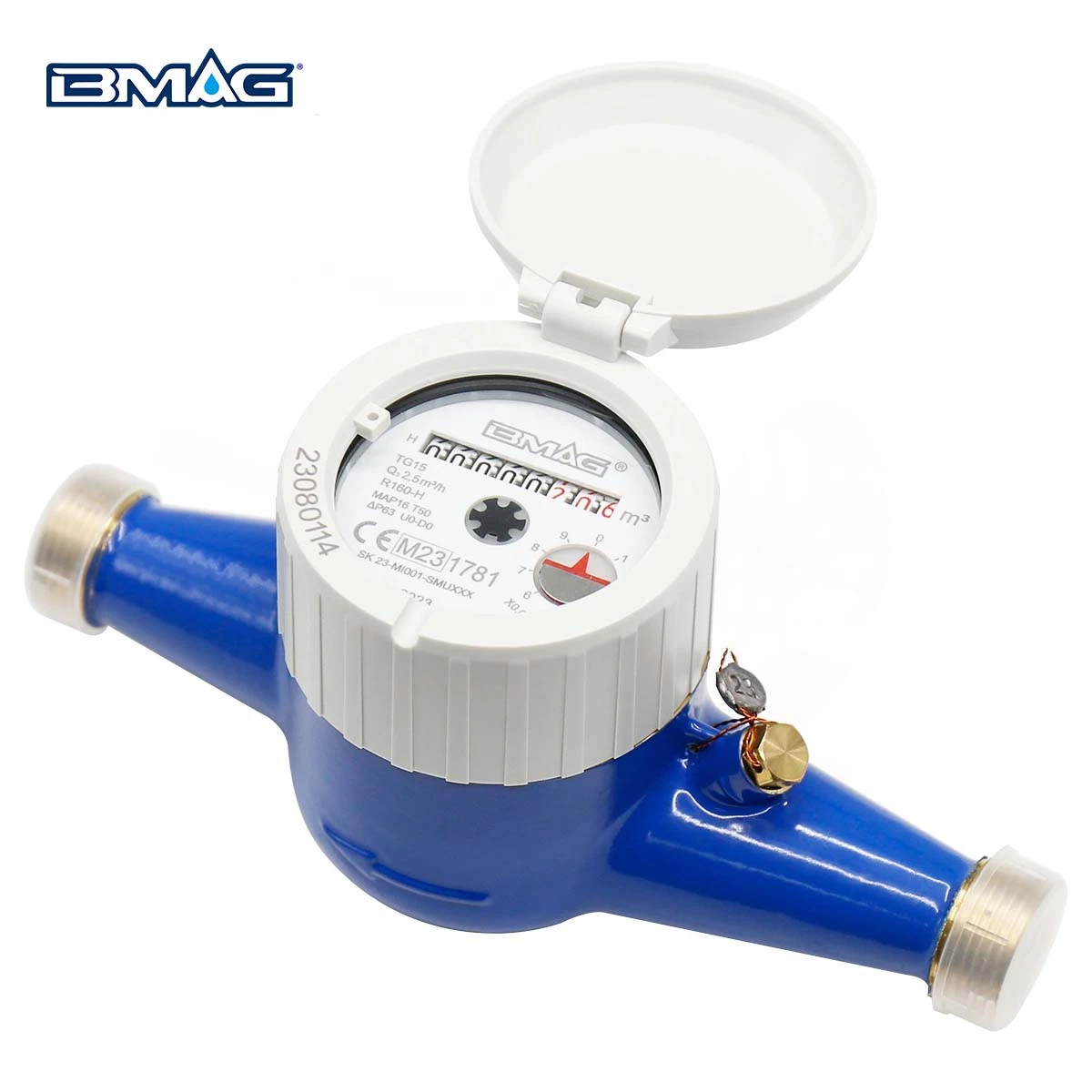
Small-diameter contatori d'acqua refer to water meters with a nominal diameter of 40 mm or smaller (DN ≤ 40). These meters typically use threaded connections.
Common sizes include:
- DN15 (1/2″)
- DN20 (3/4″)
- DN25 (1″)
- DN32 (1-1/4″)
- DN40 (1-1/2″)
These sizes cover most water metering requirements for residential properties, apartments, small commercial premises, and some small industrial facilities, forming a large and fundamental part of urban water metering systems.
BMAG Small Diameter Water Meter Recommendations
BMAG is a professional water meter manufacturer specializing in water metering solutions for residential, commercial, industrial, and utility applications.
BMAG offre DN15–DN40 small-diameter water meters, including multi-jet, single-jet, volumetric, and ultrasonic models for residential, commercial, and submetering applications.
Recommended products include:
Lead-free brass multi-jet water meter designed for the North American market, with NSF certification, AWWA C708 compliance, and optional pulse output.

Volumetric rotary piston meter with R160/R200 options, suitable for residential and other applications where low-flow measurement is important.

DN25 multi-jet water meter with R160 horizontal accuracy, MID certification, and optional pulse output.

DN15–DN40 dry-type multi-jet water meter with a brass body and R80/R100/R160 options.

Brass single-jet meter designed for hot-water measurement, with operating temperatures up to 90°C.

Smart ultrasonic water meter covering DN15–DN40, with high turndown ratios, IP68 protection, remote communication, and automated valve control.

Features of Small Diameter Water Meters
1. Threaded Connections
Small-diameter water meters generally use threaded connections, which provide a compact and economical connection for small pipelines. BSP, NPT, and other thread standards may be available depending on the product and target market.
2. Compact Design
Small-diameter water meters are compact and relatively lightweight, making them easier to transport and install in large quantities. Their small footprint also makes them suitable for indoor installations, residential units, meter boxes, pipe shafts, and other space-limited locations.

3. Multiple Body Materials
Small-diameter water meters are available in lead-free brass, plastics/composites, cast iron, and stainless steel, depending on the application.
Lead-free metal bodies provide strength and potable-water suitability, while polymer bodies offer low weight, corrosion resistance, and cost efficiency. Stainless steel can be selected where higher corrosion resistance or more demanding service conditions are required.
4. Multiple Metering Technologies
Traditional small-diameter water meters commonly use positive displacement or velocity-based measurement. Typical examples include rotary-piston volumetric meters and multi-jet velocity meters.
Smart small-diameter meters may use ultrasonic or electromagnetic technologies. Ultrasonic meters, for example, have no moving measuring components and can provide wide measurement ranges with reduced mechanical wear.
Main Applications
Small-diameter water meters are commonly used for:
- Residential water metering
- Apartments and submetering
- Small commercial premises
- Small businesses and industrial facilities

Advantages of Small Diameter Water Meters
Good Low-Flow Measurement Performance
Small-diameter water meters are well suited to low and intermittent flow conditions and can provide good sensitivity at lower flow rates. Volumetric meters in particular can have low starting flows and strong low-flow performance, making them suitable for residential consumption and individual household metering.
Lower Cost and Compact Footprint
Small-diameter water meters require relatively little installation space and can be conveniently installed in meter boxes, pipe shafts, and other confined locations. Their smaller size and lower material requirements can also help reduce overall costs, making them suitable for projects requiring large numbers of individual meters.
Key Parameters of Small Diameter Water Meters
| Key Parameter | Typical Specification / Range | Selection Focus |
| Nominal Diameter (DN) | DN15, DN20, DN25, DN32, DN40 | Select according to actual minimum, normal, and peak flow requirements while also confirming the pipeline connection size |
| Q₁ Minimum Flow Rate | Varies with DN, metering technology, and R ratio; small meters can reach tens of L/h or lower, while BMAG ISO/OIML models cover approximately 3.97–200 L/h | For applications with prolonged low flow, low occupancy, or greater low-flow measurement requirements, prioritize a lower Q₁ |
| Q₃ Permanent Flow Rate | Typically from several m³/h to tens of m³/h; representative values are approximately 2.5–16 m³/h | Normal continuous system flow should remain within Q₃, with an appropriate margin for peak demand |
| Q₄ Overload Flow Rate | Representative values are approximately 3.125–20 m³/h | Ensure short-duration peak flow does not exceed Q₄ |
| Turndown Ratio R (Q₃/Q₁) | Commonly R80, R100, R160, and R200; some smart ultrasonic meters offer higher ratios such as R400 and above | Higher R ratios are useful where water demand varies widely or low-flow measurement is particularly important |
| Starting Flow Rate | Generally below Q₁ and varies with volumetric, single-jet, multi-jet, and other mechanical designs | If very small leaks or extremely low flows are important, compare the manufacturer’s specified starting flow |
| Perdita di pressione | Mechanical models may be rated Δp63; some high-range/ultrasonic models are available with Δp40 | Lower pressure loss is preferable in low-pressure systems or where peak flow demand is high |
| Maximum Allowable Working Pressure | Commonly MAP10 / MAP16, or 10–16 bar (1.0–1.6 MPa) | The pressure rating should meet the normal system operating pressure while also considering possible pressure fluctuations |
| Operating Temperature | Cold-water models commonly use T30 / T50 (up to approximately 50°C); hot-water models can reach T90 / 90°C; North American models may be rated for 105°F cold water and 160°F hot water | Select a cold-water or hot-water meter according to the actual fluid temperature |
| Installation Orientation | Horizontal and multi-orientation models are available | Confirm that the selected meter is approved for the actual pipeline orientation |
| Communication Method | Pulse, M-Bus, RS485, wM-Bus, LoRa, LoRaWAN, NB-IoT, ecc. | Select according to the AMR/AMI system, BMS, billing platform, and on-site network conditions |
| Ingress Protection | IP65, IP67, IP68, depending on model and component | Higher protection should be considered for meter pits, underground installations, humid environments, or locations with a risk of flooding |
| Metering Error / MPE | ISO/OIML models: typically ±5% for Q₁≤Q<Q₂; for Q₂≤Q≤Q₄, typically ±2% for T30 E ±3% for T50 | For residential billing and trade settlement, confirm the type approval and permissible error requirements of the specific model |