Trockener Wasserzähler - Ein freundlicher Leitfaden
The design philosophy of the dry dial Wasserzähler lies in “isolation,” which means that through a sophisticated mechanical structure, the most vulnerable counter part is isolated from the complex and ever-changing water environment, thus achieving long-term, stable and accurate measurement.
In addition to standard residential or commercial settings, dry dial water meters are highly adaptable to the following environments:
Environments with frost or poor water quality
Outdoor, industrial, and agricultural irrigation applications
Hot and cold water systems
Product Recommendation -BMAG Dry Dial Water Meter
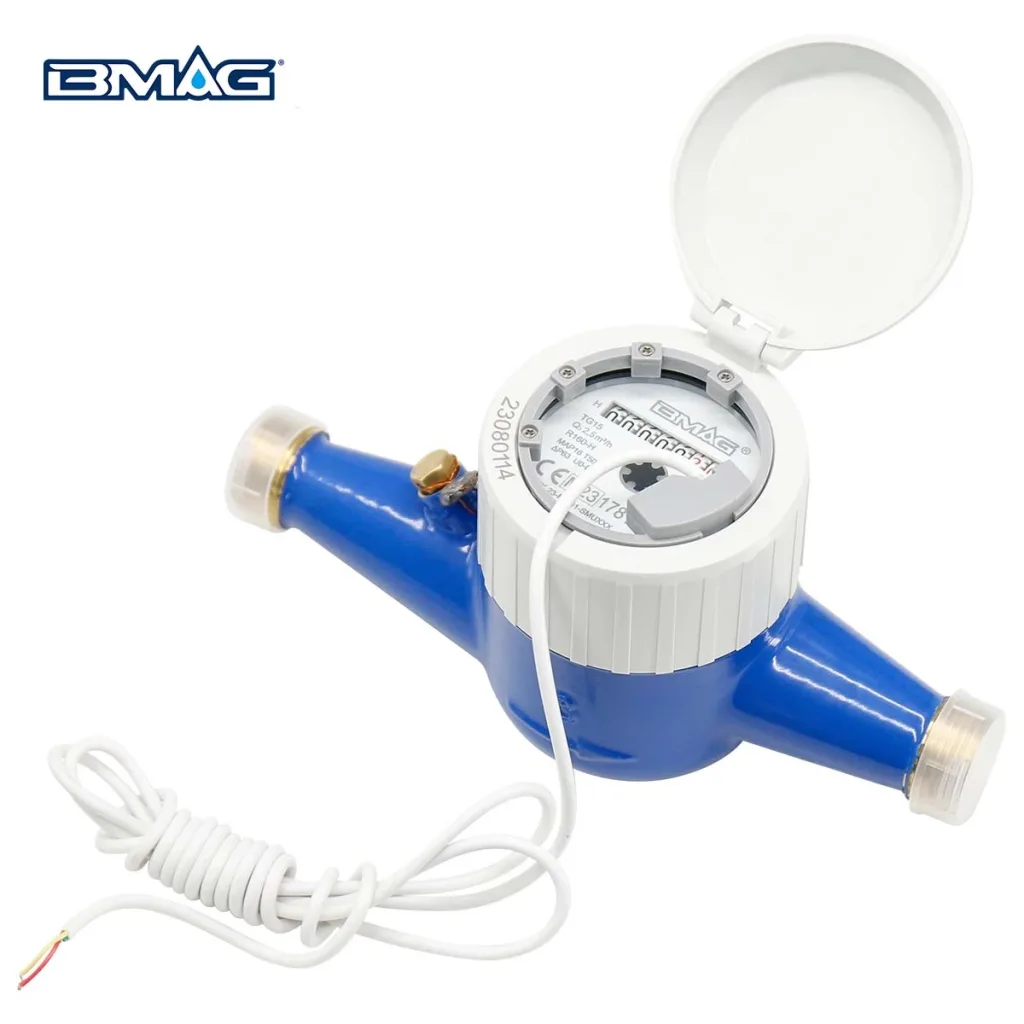
Mehrstrahl-Wasserzähler aus Messing mit Impulsausgang | 360° drehbar | IP68 | Fernablesung
As the name suggests, the core feature of the dry dial water meter is that the counter (register) or indicating mechanism is completely isolated from direct contact with the measured water flow. This design is achieved through its key technology—magnetic coupling.
The working process is as follows:
Measurement mechanism senses flow: When water flows through the metering chamber inside the water meter, it drives a measuring element with a built-in magnet (usually an impeller or rotor) to rotate. This measuring element is the only dynamic part that is in direct contact with the water.
Magnetic non-contact transmission: The rotation speed of the measuring element is proportional to the water flow speed. The magnetic field lines generated by its built-in driving magnet penetrate a completely sealed isolation plate.
Counting mechanism rotates synchronously: On the other side of the isolation plate (i.e., in the dry counter chamber), there are one or more driven magnets. Under the magnetic force of the driving magnet, the driven magnets are driven to rotate synchronously.
Gear train and dial display: The rotation of the driven magnets is reduced and transmitted through a set of precision gear mechanisms, finally driving the pointer or number wheel on the dial to rotate, thereby displaying the accumulated water consumption.
Through this magnetic coupling non-contact transmission method, the “heart” of the water meter—the measuring mechanism—and the “brain” of the water meter—the counting mechanism—are physically completely separated. The counter is encapsulated in a sealed, dry chamber, which in some designs may be evacuated or filled with dry or inert gas to further prevent condensation. This structure protects the register from suspended impurities, mineral scaling, corrosion, and fogging caused by temperature differences, ensuring long‑term clarity and reliable indication.
Key Technical Features
The superior performance of the dry dial water meter stems from the synergistic effect of several key technical designs.
1. Hermetically Sealed Register
This is the most distinctive feature of the dry dial water meter. The counter is encapsulated in a sturdy transparent cover and is highly sealed, can reach IP68 protection level. This design offers two major advantages:
It completely eliminates the problem of blurred readings in wet-type water meters caused by water vapor condensation on the inner glass surface when there is a significant temperature difference between the inside and outside (especially in cold climates or hot water applications).
Even in environments with poor water quality containing sediment, rust, or suspended solids, the counter and gear mechanism remain clean and free from clogging, wear, or corrosion, ensuring long-term clear readings and extended operational life.
2. Magnetic Coupling Drive
Magnetic coupling is the core technology of dry dial water meters. Modern dry dial water meters typically use high-performance permanent magnet materials (such as neodymium iron boron) to ensure strong and stable magnetic transmission. To address the potential risk of external magnetic field interference—a weakness of early dry dial water meters—many high-end products incorporate anti-magnetic designs. This is usually achieved by adding a magnetic shielding ring around the counter or using a special magnetic circuit design, effectively resisting malicious interference from strong external magnetic fields and ensuring the accuracy of measurement.
Dry Dial Water Meter vs. Wet Dial Water Meter
Trockener Wasserzähler
Wet Dial Water Meter
What are the advantages of a dry dial water meter compared to a wet dial water meter?
Compared to wet dial water meters where the counter is completely immersed in water, the advantages of dry dial water meters are comprehensive and extremely significant.
Stronger pollution and interference resistance are the core advantages of dry dial water meters.Because the counting mechanism is isolated from the water flow, any impurities in the water, such as sediment, scale, rust, and algae, will not enter the precision gear system. This allows dry dial water meters to maintain long-term stable operation even in areas with poor water quality, high hardness, or aging pipe networks, unlike wet dial water meters which can experience increased measurement errors or even stop working due to impurity blockage.
Clear readings.Dry dial water meters largely solve the problem of fogging and condensation caused by temperature differences between the inside and outside of the meter cover under specific conditions (such as cold weather, hot water pipes, and humid environments).
Wider water adaptability.Dry dials are better suited than wet dials to water with more impurities or hardness because the register stays clean and readable under conditions that quickly degrade wet dials.
Frost protection advantage.In cold regions, water meter freezing is a serious problem. For wet dial water meters, the force of freezing expansion directly acts on the meter cover glass, easily leading to glass breakage and leakage. In a dry dial water meter, the register chamber is sealed and normally not filled with pressurized water, so the glass over the dial is less directly stressed by freezing in the measuring chamber.Even if the water in the metering chamber freezes, causing damage to the meter body or glass,the sealed register reduces the likelihood and volume of water escaping through the dial area, thereby lowering the risk and extent of secondary damage from flooding.
Longer service life and lower life cycle costs.Because its core counting mechanism is protected from water erosion and wear, the mechanical life of a dry dial water meter is usually significantly longer than that of a wet-type water meter, especially in systems with poor water quality or large temperature variations. Although its initial purchase cost is slightly higher, the reduced risk of register‑related failures, less need for cleaning due to dial contamination or fogging, and the potential for a longer replacement interval can result in a more favorable overall life‑cycle cost in many applications.
What are the disadvantages of dry dial water meters compared to wet-type meters?
Despite its obvious advantages, dry dial water meters also have some inherent limitations.
Higher initial purchase cost.The structure of a dry dial water meter is relatively complex, and its manufacturing process involves precise magnetic coupling components and high-standard sealing technology, which results in its production cost usually being20–30% higherhigher than that of acomparablewet-type water meter.
Sensitivity to strong external magnetic fields.Magnetic transmission is the basis of its operation, but it also constitutes a potential weakness. If the water meter is exposed to a sufficiently strong external magnetic field (for example, someone maliciously using a strong magnet), it may interfere with or shield the coupling between the internal magnets, causing the metering to slow down, become inaccurate, or even stop.
However, modern anti-magnetic designs have greatly improved its anti-interference ability, allowing it to withstand conventional strength magnetic fields.
Differences in transmission sensitivity and accuracy.Theoretically, under ideal laboratory conditions with excellent water quality and stable flow rate, the impeller of a wet-type water meter directly drives the counter through gears, resulting in the highest transmission efficiency and potentially slightly better sensitivity than a dry dial water meter, which requires magnetic coupling. Therefore, in some applications requiring extremely low starting flow rates, the highest-end wet-type water meters may show a slight accuracy advantage. However, in the complex application environment of the real world, this small difference is quickly offset or even surpassed by the long-term accuracy stability maintained by the dry dial water meter due to its resistance to contamination.
Repair Complexity.Dry dial water meters require very little daily maintenance. However, once internal core components (such as the magnetic coupling mechanism or sealed chamber) are damaged, their repair is usually more complex than that of wet-type water meters, often requiring specialized equipment and technology, and may even require factory repair, so in some cases replacement rather than repair is the more practical option.