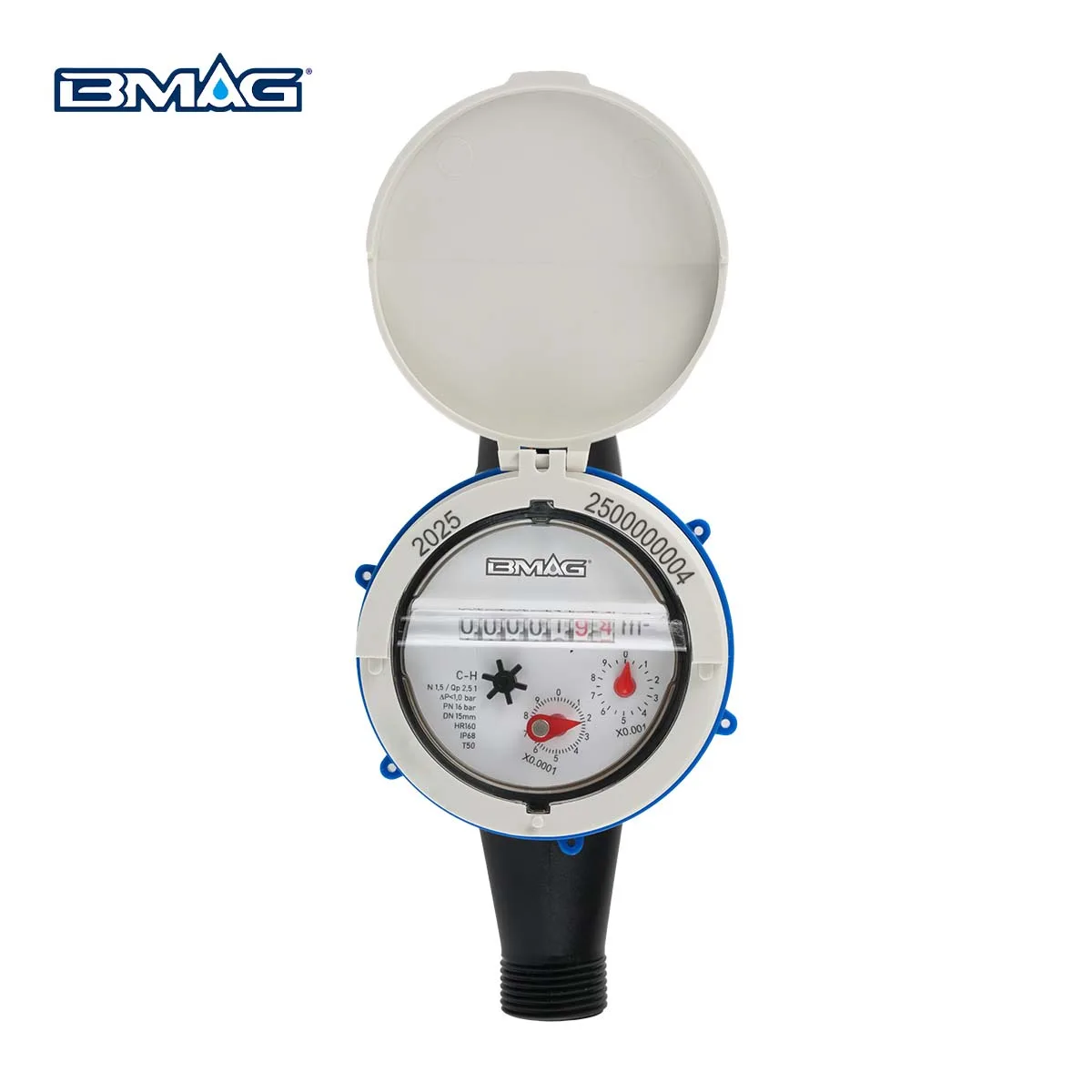
Most ultrasonic water meters work on something called the transit time method. You might’ve heard of the Doppler effect in flow measurement as well, but in the water meter world, transit time is the go-to.
“Transit time”means: Ultrasonic water meters use an ultrasonic sensor installed inside the water pipe to emit sound waves and measure the speed of sound waves in water. By measuring the difference in speed between upstream and downstream, the water flow velocity is calculated and the flow rate is derived.


What’s Inside an Ultrasonic Water Meter
Ultrasonic Transducers: These are the core components of an ultrasonic water meter, responsible for transmitting and receiving ultrasonic signals to measure fluid flow rate.
Microprocessor/Signal Processing Unit: This unit processes the data collected by the sensors, performing signal processing, filtering, analog-to-digital conversion, and other operations, converting the processed data into readable flow information.
Flow Tube/Measuring Channel: This pipe provides a path for water flow and is used to mount the ultrasonic transducer used to measure water velocity.
Display: This displays meter readings, such as flow rate and accumulated flow, for the user to view.
Communication Module: This is the medium for transmitting data between the ultrasonic water meter and external devices (such as a host computer or remote server), enabling remote monitoring and data management.
Housing: This protects the internal components of the water meter and is typically made of waterproof, high-quality materials.
Power: This unit provides electrical power to the ultrasonic water meter.

Ultrasonic Water Meter Working Principle And Flow Calculation Process
As mentioned at the beginning of this article, the operating principle of ultrasonic water meters is based on the transit time method. Its core idea is to calculate the flow rate by measuring the time difference between ultrasonic waves traveling upstream and downstream of a fluid. Below, we will explain the operating principle of ultrasonic water meters and the flow rate calculation process step by step:

Step 1: Signal Transmission and Reception
An ultrasonic water meter contains multiple ultrasonic transducers (usually two or more pairs), located upstream and downstream of the pipe. These transducers transmit and receive ultrasonic signals. One transducer transmits the ultrasonic signal, while the other receives it.
Step 2: Signal Propagation and Time Difference Measurement
When an ultrasonic signal propagates through a fluid, its propagation speed is affected by the fluid’s flow rate. Ultrasonic waves travel faster downstream (in the same direction as the fluid flow) than upstream (opposite to the fluid flow). Therefore, there is a difference in the propagation time between upstream and downstream, which is called the transit time difference.
Step 3: Data Processing and Calculation
The ultrasonic water meter measures the propagation time difference between the downstream and upstream flows and, combined with the geometric parameters of the pipe (such as pipe diameter, transducer spacing, etc.), calculates the flow velocity through a mathematical model. The relationship between flow velocity and time difference is usually expressed by the following formula:
Where:
vm=Average axial velocity of the fluid
L=Ultrasonic path length
φ=Ultrasonic path angle
tr=Ultrasonic wave propagation time in the fluid downstream (from A to B)
ts=Ultrasonic wave propagation time in the fluid upstream (from B to A)
Step 4: Flow Calculation
After obtaining the fluid velocity, combined with the pipe’s cross-sectional area A, the instantaneous flow rate can be calculated.
Calculate Pipe Area:
Where:
A = cross-sectional area of the pipe
D = internal diameter of the pipe
Where:
K = velocity distribution coefficient
dt = time integral
S = cross-sectional area of the pipe segment
The accumulated flow can also be obtained through integration or accumulation.
Working Principles: Ultrasonic VS Mechanical Water Meters
The working principles differences between ultrasonic and mechanical water meters lead to differences in their performance, particularly accuracy and pressure loss.
Mechanical water meters operate based on the rotation of mechanical moving parts (such as impellers or gears), measuring water consumption by measuring the volume or velocity of the fluid. The movement of mechanical parts makes them susceptible to wear, clogging, and other interference, resulting in reduced accuracy. Furthermore, the presence of moving parts and flow resistance devices results in significant pressure loss and increased energy consumption.
Ultrasonic water meters operate based on the ultrasonic transit time method, transmitting and receiving ultrasonic signals to measure water flow velocity and thus calculate flow rate. Its core principle is to use the difference in ultrasonic wave propagation time in the downstream and upstream directions to calculate flow velocity, and thus flow rate. Ultrasonic water meters have no moving parts, so their accuracy remains stable during use and does not degrade significantly over time. They also offer advantages such as no flow resistance, minimal pressure loss, and lower energy consumption. Furthermore, their low starting flow rate and wide rangeability make them particularly effective at measuring low flows, reducing metering errors.
Quick comparison:
| Advantage | अल्ट्रासोनिक जल मीटर | Mechanical Water Meters |
| Working Principle | Transit time of ultrasonic sound waves | Mechanical rotation of impellers or pistons |
| Accuracy | High accuracy; stable over time; performs well at low flow | Accuracy declines due to wear; struggles at low flow |
| Ratio (Take BMAG water meter as an example) | R80 – R100 – R160 – R200 – R400 | R80 – R100 – R160 |
| Moving Parts | None | Impellers or gears |
| Pressure Loss | Low — minimal flow obstruction | Higher — parts obstruct flow causing pressure drop |
| Durability | High durability under varied conditions | Prone to damage from pressure, debris, wear |
| Advanced Features | Supports remote reading, leak detection, bidirectional flow | Limited or no digital features |