Flow meters and water meters are often considered two distinct measuring devices in both everyday contexts and specific applications. On the one hand, they differ in their definitions, application scenarios and functions, materials and designs, and accuracy and linearity requirements. On the other hand, a thorough analysis of their technical essence, operating principles, core construction, and development trends reveals profound inherent connections and commonalities. This article will provide a comprehensive understanding of their differences and similarities.
Flow Meter vs. Water Meter: Differences
1. Different Definitions
Broadly speaking, a flow meter is an instrument used to measure the flow rate or accumulated flow of a fluid (liquid, gas, slurry, or steam, for example) in a pipeline. It can measure instantaneous flow, accumulated volume, or mass flow. In a narrower sense, a flow meter refers more to an instrument used to measure the instantaneous flow of media such as gases and liquids. Compared to water meters, it generally has a wider range of applications and higher accuracy. This article primarily compares flow meters in the narrower sense with water meters.
A 水道メーター is actually a subset of flow meters, primarily used to measure the accumulated flow of water. Its function focuses on recording water consumption and is generally not primarily focused on measuring instantaneous flow.
Simply put, a water meter tells you “how much water has been used over a period of time,” while a flow meter tells you “how fast the water/fluid is flowing at a given moment,” and can calculate the total amount based on this information.
2. Different Applications and Functions
Water meters have a highly specialized application scenario, primarily for residential and commercial water supply metering. This includes water consumption statistics and billing in residential homes, apartments, office buildings, shopping malls, and other settings. While water meters are used in some industrial and agricultural irrigation scenarios to monitor and measure total water consumption, these are typically used for cost accounting rather than precise process control.

Flow meters can measure not only water but also other liquids and gases, encompassing nearly every modern industrial sector. The purpose of a flow meter varies depending on the specific application. For example, in production or experiments, they are used to ensure accurate formulations and stable processes; in energy management, they are used to monitor energy consumption and calculate costs. They are also used for automated control and remote monitoring.

Different Materials and Designs
Due to the differences in the fluids they measure, the materials used vary. While both require corrosion resistance, high temperature resistance, and high pressure resistance, flow meters often face more extreme industrial applications.
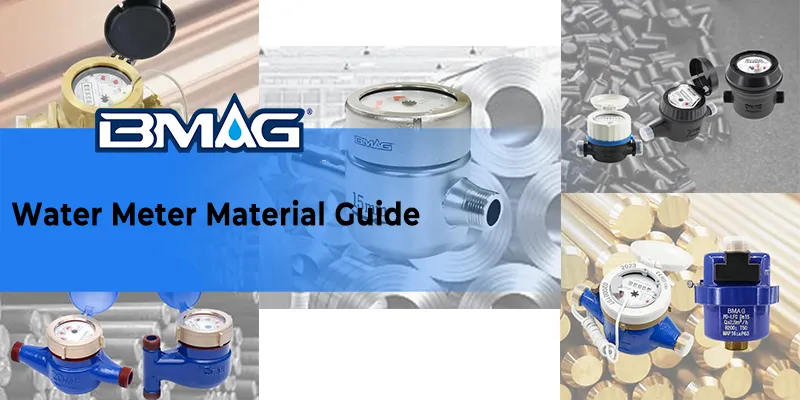
Water meters are typically made of cast iron, brass, bronze, lead-free metal, plastic, or stainless steel. Flow meters are primarily made of stainless steel, with titanium and platinum also used in some special scenarios.
3. Different Accuracy and Linearity Requirements
In general, industrial flow meters have much higher accuracy than water meters. Water meter accuracy requirements are primarily determined by metrology regulations used for trade settlements, and typically fall within the ±2% to ±5% range. While the accuracy of industrial flow meters varies significantly depending on their operating principle and application scenario, it is generally higher than that of water meters. For example, Coriolis mass flow meters offer the highest accuracy, typically reaching ±0.1% to ±0.2% or even higher.
Linearity is crucial for industrial flow meters. Because process flow rates often fluctuate, engineers need to ensure reliable measurement at both maximum and minimum flow rates. A highly linear meter, even with initial errors, is more easily calibrated to achieve high global accuracy.
Water meters, especially mechanical ones, exhibit naturally nonlinear error curves due to factors such as friction, resulting in different physical properties at low and high flows. To address this, engineers set reasonable, acceptable error ranges for different flow ranges (low, transitional, and high flows), thereby creating segmented accuracy standards. This practical approach has been embraced by regulatory standards such as ISO 4064, which specify performance criteria based on flow range rather than strict linearity requirements.
Thus, compared to flow meters requiring higher linearity, water meters have been subject to regulatory standards that accept their nonlinear characteristics and replace the need for high linearity with segmented accuracy requirements. For example, these requirements define minimum flow (Qmin), transition flow (Qt), and nominal flow (Qn), each with its own specified accuracy limits.

4. Different Standards
Water meters are typically required to comply with national and regional water measurement standards, such as ISO4064:2024 (which specifies technical requirements for hot and cold water meters) and the American Water Association standard AWWA C700 (displacement type). These standards specify accuracy levels, installation, and testing procedures to ensure that manufactured water meters are suitable for water bill calculations.
Industrial flowmeters adhere to a more complex system of standards, including international standards for specific principles (such as ISO 5167 for differential pressure flowmeters), recommendations from the International Organization of Legal Metrology (OIML) (such as OIML R 137 for gas flowmeters), and national metrological verification procedures (e.g., China’s JJG series, such as JJG 1033 for electromagnetic flowmeters and JJG 1038 for mass flowmeters). These standards detail the definitions and test methods for different accuracy levels (e.g., 0.2, 0.5, and 1.0).
Flow Meter vs. Water Meter: Similarities
- The fundamental function of both is to quantitatively measure the movement of fluid within a pipe, the difference being that one measures instantaneous flow (the velocity of the fluid at a specific moment), while the other measures cumulative flow (the total flow over a period of time).
- The technology used in water meters is essentially a selection and optimization of various operating principles of flow meters, such as mechanical (turbine or piston), ultrasonic, and electromagnetic.
- The core structure of both is similar, typically consisting of a sensor (or transducer) to detect fluid flow, a converter to receive and convert the sensor signal into data, and a display or output unit to visually display the resulting data.
- Although their accuracy differs, both pursue higher precision in their respective fields. Water meters require long-term reliability and billing accuracy, while flow meters require real-time responsiveness and adaptability to a variety of fluids.