Gas meters and water meters are both common metering devices in residential areas, but sometimes it’s difficult to clearly distinguish or identify them. This article will explain several differences between the two and provide quick methods to distinguish them.
(Note:This article discusses the differences and distinctions between gas meters and water meters in household or general situations, and does not cover industrial or other special situations.)
Gas Meter vs Water Meter: Definition and Usage
A gas meter, as the name suggests, is a specialized instrument used to accurately measure and record the volume of gas (such as natural gas and liquefied petroleum gas) consumed. Its core function is to automatically accumulate a user’s gas usage over a certain period, providing a billing basis for gas suppliers and helping users understand their energy consumption.
A water meter measures the total amount of water flowing through a water supply pipe and is the primary basis for water companies to charge residential and commercial customers. It is also a crucial tool for water management, monitoring, and conservation.
Gas Meter vs Water Meter: Appearance
A residential gas meter is typically a rectangular box with a white, beige, or gray housing. Compared to a water meter, it is relatively larger, measuring, for example, 323 mm x 224 mm x 221 mm. A gas meter’s two pipe connections (one inlet and one outlet) are typically located side by side at the top of the meter.

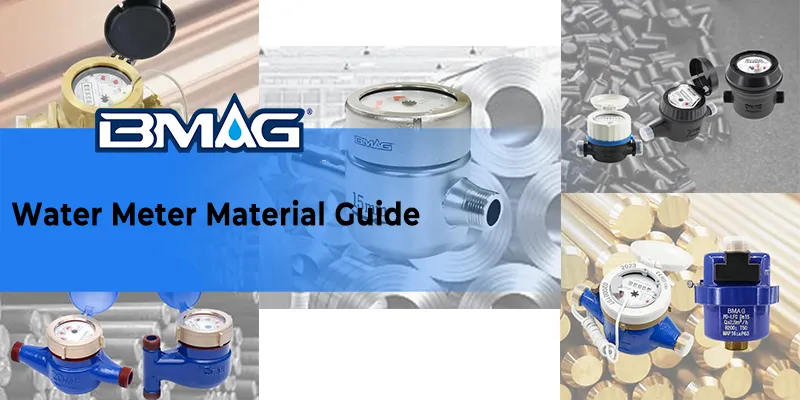
Water meters are typically smaller than gas meters, taking on a cylindrical or spherical shape; there are also smart models shaped like rectangular boxes. Box-shaped water meters typically range from 165mm to 225mm in length, 125mm in width, and 102mm to 112mm in height. Water meters are typically blue, black, red, or yellow. The two pipe connections are typically located on either side of the meter body, forming a straight horizontal line.


Gas Meter vs Water Meter: Installation Locations
Gas meters cannot be installed in enclosed spaces. They require proper ventilation and should not be installed too close to heat sources such as gas stoves. To mitigate the risk of gas leaks accumulating in confined spaces and potentially causing explosions, gas meters are typically installed outdoors in well-ventilated areas, such as near the exterior walls of a house.
In modern high-rise residential buildings, when outdoor installation is not possible, they are typically installed in dedicated metering rooms or riser shafts with adequate ventilation and fire protection. Installation in enclosed, humid, or poorly ventilated areas such as bedrooms, bathrooms, and toilets, as well as in stairwells and public corridors where safe evacuation is impeded, is not recommended.
Water meters offer more flexible installation options. They can be installed indoors in public areas or outdoors in dedicated meter boxes or meter shafts. Common installation locations include basements, garages, storage rooms, hallways, stairwells, kitchens, bathrooms, and patios.
See this blog post for more details: https://www.bmagmeter.com/where-is-my-water-meter/
Gas Meter vs Water Meter: Reading Methods
Water and gas meters are read in essentially the same way. Smart water or gas meters display the reading directly via an LCD screen or remote software. Dial-type gas or water meters require reading each pointer position from left to right to obtain the total reading. Dial-type gas or water meters require reading the pointer position. If the pointer is between two numbers, always take the smaller value. For example, if the pointer is between 3 and 4, record it as 3.
See this blog post for detailed reading instructions: https://www.bmagmeter.com/how-to-read-a-residential-water-meter/
Water meters typically include a red triangle pointer (or similar flow indicator) to detect leaks, while most gas meters do not.
How to Distinguish Water and Gas Meters: A Quick Guide
1. Distinguishing by Marking
Sometimes, gas meters will have the word “Gas” marked on the outer casing and warning signs such as anti-tampering warnings; water meters usually have an arrow indicating the installation direction.
2. Distinguishing by Shape and Color
Gas meters are box-shaped. They are typically white, beige, or gray.
Water meters are cylindrical or spherical, and also box-shaped, but smaller than gas meters. They are typically blue, black, red, or yellow.
3. Distinguishing by Pipe Connection Location
Water meters have two pipe connections on opposite sides, while gas meters typically have two pipe connections on the same side, above the box.
자주 묻는 질문
Why are both meters measured in cubic meters?
Both gas and water meters can use the cubic meter (m³) as their unit of measurement, as this unit accurately reflects the volume of water or gas and is widely recognized internationally. Using the cubic meter helps standardize measurement standards and facilitates billing and management.
Note: water meters also use units other than cubic meters, such as gallons and liters, due to varying usage practices in different countries and regions.
Can I move or replace them myself?
The meter is typically managed by the utility, not the homeowner. Unauthorized removal or tampering with a gas meter may be a criminal offense in some jurisdictions.
In addition, improperly replacing a gas meter can create risks of leaks and lead to fire, explosion, or carbon monoxide (CO) poisoning. Improperly replacing a water meter can lead to leaks, backflow, and water contamination.
Therefore, we should never arbitrarily replace metering devices, especially gas meters, otherwise result in personal injury, death, and property damage.