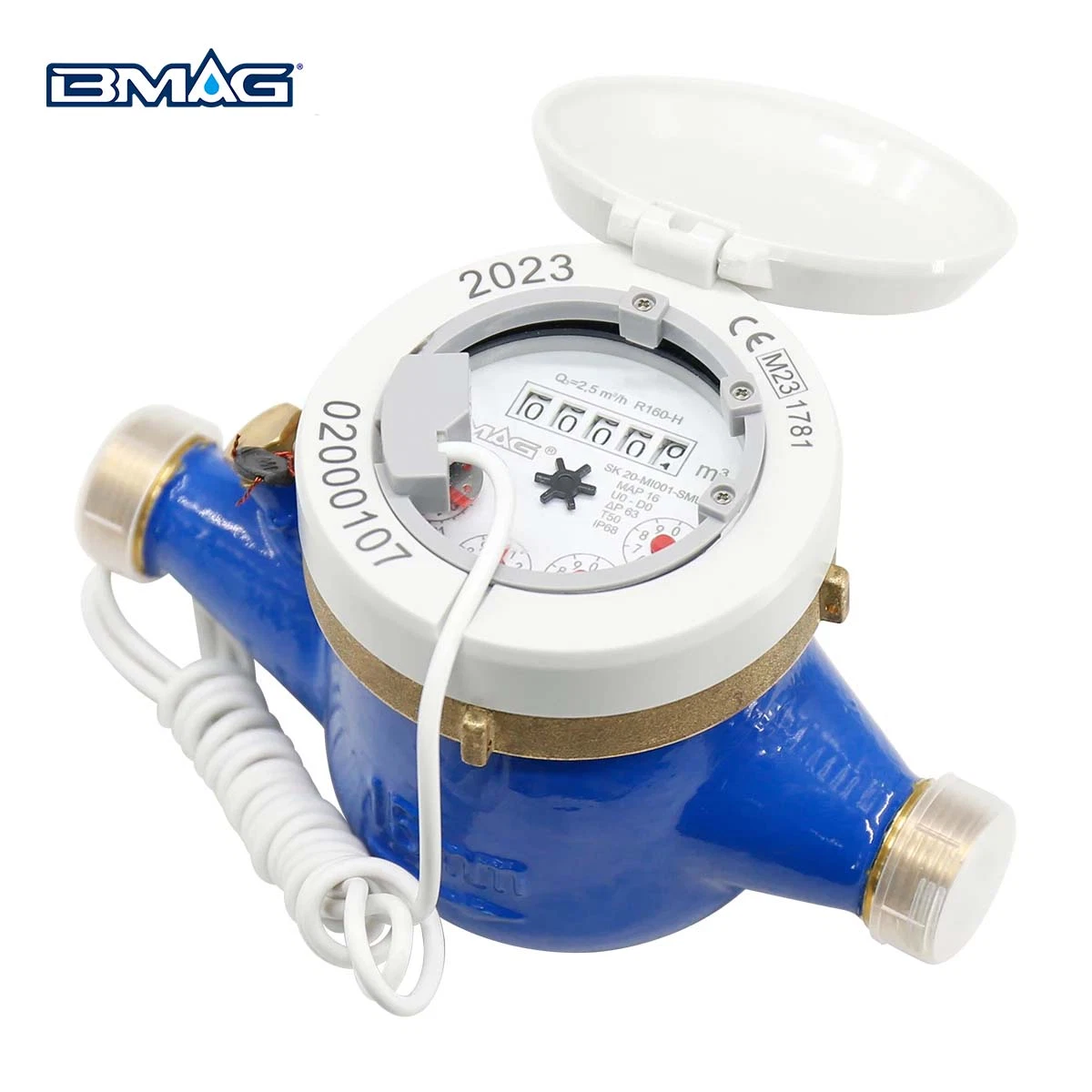
Residential Water Meter is a metering device used to measure residential water consumption and is usually installed in residential buildings to ensure that billing is based on actual consumption. The setting of Residential Water Meter not only helps to measure water consumption, but also prevents the waste of clean water, and by reading the water meter data, consumers can better manage water consumption, check for leaks, and provide utility bills based on water consumption.
Type1: Mechanical Residential Water Meters
Mechanical Residential Water Meters can be divided into two categories: Velocity Water Meters and Volumetric Water Meters. Velocity Water Meters measure the velocity of water flow by rotating the impeller driven by water flow. Volumetric Water Meters measured by filling and draining the meter chamber with a known volume of water one by one.
Single Jet Residential Water Meter is characterized by water flow entering the impeller through a nozzle and impacting a certain point on the edge of the impeller. This design makes the Single Jet Water Meter less expensive.
However, its measurement accuracy is not as good as the Multi Jet Water Meter because the unilateral impact of the water flow causes the impeller bearing to wear faster, thus shortening its service life. In addition, the Single Jet Water Meter is more sensitive to sediment in the fluid and is prone to measurement errors.
Multi Jet Residential Water Meter divides the water flow into multiple small streams and impacts multiple parts of the impeller at the same time. This design improves the accuracy and reliability of the measurement and is suitable for long-term use. The Multi Jet Water Meter is usually used in applications that require high-precision metering, such as sub-metering applications in residential and commercial buildings.
The main difference between the Single Jet Residential Water Meter and the Multi Jet Residential Water Meter is that the water flow impacts the impeller in different ways. The former is a single stream impact, while the latter is a multi-stream impact at the same time. The Multi Jet Water Meter is superior to the Single Jet Water Meter in terms of accuracy and durability, but the cost is also relatively high.
The subcategories of volumetric water meters mainly include Rotary Piston Type and Disc Type.
Rotary Piston Type
Disc Type Water Meter
Rotary Piston Type Water Meter is characterized by high metering accuracy, suitable for metering of small flow rates, and high sensitivity. It is usually used for metering pure water in small-diameter pipes.
Disc Type Water Meter uses a rotating disc to measure the flow rate. The water flow drives the disc to swing, and the water volume is calculated by counting the number of disc swings. The Disc Type Water Meter is characterized by a relatively simple structure, but its metering accuracy and stability are not as good as the Rotary Piston Type Water Meter.
The main difference between the Rotary Piston Type Water Meter and the Disc Type Water Meter lies in the different metering mechanisms: the former uses a rotating piston, and the latter uses a rotating disc. Rotary Piston Type Water Meter is suitable for small flow measurement with high accuracy, but has high requirements for water quality. Disc Type Water Meter has a simple structure, but relatively low measurement accuracy.
Type2: Electronic Residential Water Meter - Ultrasonic Water Meter
Electronic Residential Water Meter is a new type of water meter using modern water meter technology. Its flow sensing part does not contain mechanical moving parts, so it is also called Solid State Water Meter. This water meter mainly uses electromagnetic, ultrasonic or jet principles for measurement, and has the advantages of no wear and durability.
Meter Air Ultrasonik are the most common type of electronic water meter used in residential applications.
Ultrasonic Residential Water Meters are a new type of water meter that uses ultrasonic technology to measure water flow rate. This water meter has the characteristics of low starting flow rate, wide range ratio, high measurement accuracy and stable operation, and there are no moving parts inside for a long service life.
There are two main subtypes of ultrasonic water meters: Transit-Time Meters and Doppler Meters.
Transit-Time Ultrasonic Water Meters is based on the time difference caused by the change in speed of sound waves when they travel in the water with and against the flow. It usually has two transducers mounted on opposite sides of the pipe, pointed at a certain angle to the direction of the water flow. Each transducer alternately sends and receives ultrasonic signals, and the flow velocity is determined by measuring the difference in the propagation time of the upstream and downstream signals, thereby calculating the flow rate.
Transit-Time Ultrasonic Water Meters are suitable for clean liquids, such as drinking water, because they are more sensitive to solids or bubbles in the fluid, which may weaken the signal strength.
Doppler Ultrasonic Water Meters are based on the Doppler effect, that is, when an ultrasonic signal is reflected by particles or bubbles in the flow, the frequency changes. This frequency change is proportional to the velocity of the fluid. Therefore, by measuring the change in the frequency of the reflected signal, the velocity of the fluid can be calculated.
Doppler Ultrasonic Water Meters are suitable for liquids containing suspended solids or bubbles, such as wastewater and slurries, because these substances can effectively reflect ultrasonic signals.
Type 3: Residential Water Meter with Pulse Output
Electronic devices have been added to some traditional residential water meters to give them additional functionality. Pulse Output Water Meter is a typical representative.
Pulse Output Residential Water Meter is a water meter for residential use with a pulse output function. This water meter transmits water flow information through a pulse signal and is usually connected to an electronic device to remotely read and monitor water usage.
Pulse Output Residential Water Meter indicates a certain amount of water passing through by generating a pulse each time water flows through. These pulses can be connected to a variety of electronic devices, such as a simple digital display or a wireless transceiver that can wirelessly transmit the pulse signal to a gateway.
Pulse Output Residential Water Meters typically use magnets and reed switches to detect water flow. When water flows through, the magnet passes over the reed switch, causing it to close and generate a pulse signal. These pulse signals can represent specific units of water volume, such as one pulse per gallon or ten pulses per ten gallons.
In addition, Pulse Output Residential Water Meters can also be used in conjunction with remote reading systems to transmit data to a central control system via wireless or wired methods, allowing real-time monitoring and management of household water consumption.
Smart Residential Water Meter is a device that uses modern microelectronics, sensing and communication technologies to measure and manage water consumption. This water meter can not only accurately measure water consumption, but also transmit data to a remote monitoring platform through a built-in communication module to achieve real-time monitoring and management of water consumption data. Smart water meters can be classified according to different standards and functional characteristics.
Prepaid smart water meter: This water meter combines metering and payment systems, and users can recharge and query through IC cards.
Split-line smart remote water meter: Data is transmitted through wired means, usually used in centralized meter reading systems.
Wireless smart remote water meter: Data is transmitted using wireless networks, suitable for remote monitoring and management.
Bluetooth water meter: Data is transmitted through Bluetooth technology, suitable for some specific application scenarios.
Subtype 2: By technical principle
Mechanical smart water meter: Uses traditional mechanical impellers or pistons as flow sensors, and is equipped with electronic devices.
Electronic water meter: Based on electronic or electromagnetic induction principles.
Subtype 3: By function and application
Prepaid water meter: Combines metering and payment functions, and users need to pay fees in advance.
Remote meter reading water meter: Can realize functions such as remote meter reading, water consumption monitoring and data analysis.
IoT water meter: Uses IoT technology to transmit data through public or private networks, supports low power consumption and large connections.
Type 5: Residential Water Meter by Installation Form
According to the installation form, Residential Water Meter can be divided into Horizontally Installed Water Meter and Vertically Installed Water Meter.
Horizontally Installed Water Meter means that the axis of the water meter is parallel to the horizontal plane, which is usually suitable for above the pipeline or in the pipeline well.
Vertically Installed Water Meter means that the axis of the water meter is perpendicular to the horizontal plane, and is usually installed in the pipeline.
The choice of these two installation methods depends on the specific installation environment and requirements. For example, in some cases, horizontal installation may be easier to read and maintain. However, some water meter designs allow installation in horizontal or vertical directions to meet different installation requirements.
It should be noted that the vertical installation water meter can only be installed vertically, and the measurement accuracy will be inaccurate if it is installed horizontally. The same is true for the water meter installed horizontally.
Residential Water meters can be divided into Cold Water Meter and Hot Water Meter according to the medium temperature. The water temperature of 30℃ is the dividing line. Specifically:
Cold Water Meter: A water meter with a lower temperature limit of 0℃ (32℉) or 0.1℃ (32.18℉) and an upper temperature limit of 30℃ (86℉) or 50℃ (122℉).
Hot Water Meter: A water meter with a lower temperature limit of 30℃ (86℉) and an upper-temperature limit of 90℃ (194℉), 130℃ (266℉) or 180℃ (356℉).
Type 7: Residential Water Meter by counter immersion
Residential water meters can be divided into Wet Dial Water Meters, Dry Dial Water Meters and Liquid-sealed Water Meters according to whether the counter is immersed in water.
Wet Dial Water Meters: The counter is immersed in water, its glass is under water pressure, and the transmission of the sensor and the counter is gear linkage. After a period of use, the quality of water will affect the clarity of the water meter reading.
Dry Dial Water Meters: The counter is not immersed in water, the sensor is isolated from the counter, and magnetic transmission is usually used. This structure makes the dry dial water meter unaffected by water quality and has a longer life, but the cost is high.
Liquid-sealed Water Meters: The counting wheel or the entire counter is sealed in a certain concentration of liquid, such as glycerin, to avoid the influence of external water quality on the counter reading. The structural performance of the liquid-sealed water meter is similar to that of the wet dial water meter, but the clarity of its counter is not affected by external water quality.